


Safety is our unwavering priority, shaping everything we do every single day.

Certified by trusted external bodies to ensure our customers’ complete peace of mind.

Creative design and smart material planning to deliver cost-efficient solutions.

Innovations for now and the future of the civil and construction industries.
How the System Operates on Site
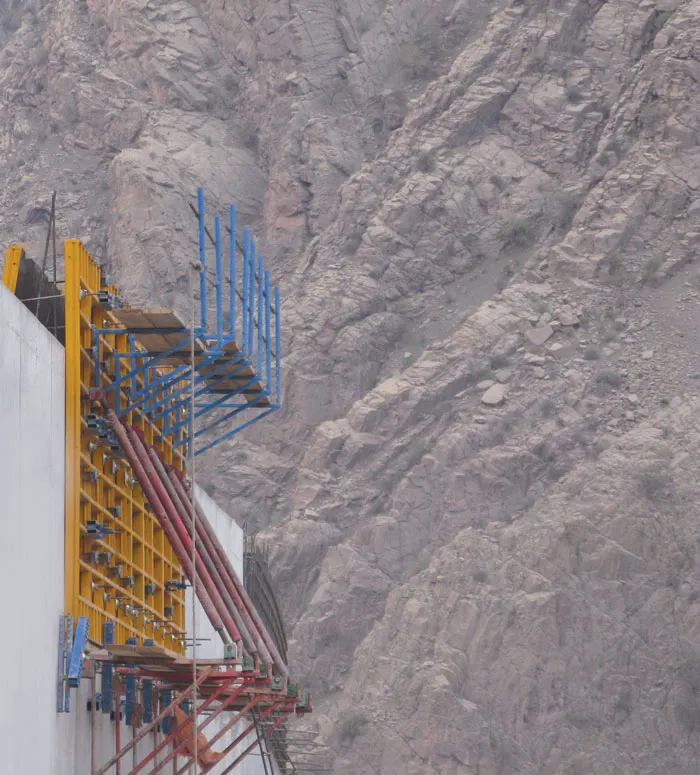
The system operates through a precisely engineered climbing sequence that synchronizes various mechanical and structural elements. Anchors or climbing rails are embedded in the concrete during casting to provide the necessary support for the subsequent lift. After curing to a specific compressive strength, hydraulic cylinders activate and lift the entire formwork assembly, including working platforms and safety screens, in a synchronized movement. Once positioned, the system locks securely and prepares for the next reinforcement and concrete pour. This controlled cycle ensures consistent geometry, minimizes alignment errors, and supports uninterrupted construction progress, which is critical for high-rise schedules and cost control. The reliability of this hydraulic movement means that even in high-wind conditions where cranes might be grounded, the self climbing mechanism can often continue its vertical ascent safely.
Main Components of the Assembly
A self climbing formwork system consists of high-strength formwork panels, hydraulic climbing units, anchoring systems, integrated working platforms, and full-height safety screens. These components are designed as a unified system to withstand vertical loads, wind pressure, and repetitive climbing cycles. From a commercial standpoint, modular compatibility with concrete formwork systems and Concrete Modular Formwork allows contractors to adapt the system to various structural layouts while maintaining long-term durability and operational safety. Every part of the assembly, from the heavy-duty brackets to the fine-tuned hydraulic valves, must undergo rigorous testing to ensure it can handle the immense pressures involved in tall building construction. This synergy between the structural formwork and the mechanical lifting units is what sets the self-climbing method apart as a sophisticated engineering marvel.
Exploring Different Types of Climbing Formwork

Climbing formwork systems are categorized into crane-dependent climbing formwork, self climbing formwork, and single-sided climbing formwork. Self climbing systems operate independently using hydraulic power, making them the preferred solution for tall structures with limited crane availability. In contrast, crane-dependent systems require external lifting and are more suitable for mid-rise projects where crane time is not at a premium. Single-sided climbing formwork is commonly used in specialized applications such as dam construction or thick retaining walls where access is limited to one side. Understanding these types allows project owners to select the most cost-effective and technically appropriate system for their specific architectural needs. Choosing the right variation ensures that the project remains within budget while maximizing the speed of the vertical path.
Key Applications in Modern Infrastructure
Self climbing formwork systems are extensively used in high-rise residential towers, commercial skyscrapers, elevator cores, stair shafts, bridge pylons, chimneys, and industrial structures. They perform exceptionally well when integrated with concrete wall formwork solutions, delivering uniform surface quality and dimensional accuracy. For contractors working on repetitive vertical elements, the system provides a scalable and reliable solution that supports both speed and structural consistency across large projects. Whether it is a complex bridge pylon with a tapering geometry or a massive skyscraper core, the adaptability of the self climbing mechanism ensures that the formwork can be adjusted to meet the unique demands of the design. This versatility makes it an indispensable tool for the modern civil engineering and infrastructure sectors.
Operational and Safety Advantages
From a business and operational perspective, the key advantages include faster construction cycles, reduced crane usage, enhanced site safety, and predictable performance. The enclosed platforms protect workers from environmental exposure while minimizing fall risks, creating a factory-like environment at great heights. Automation reduces manual handling and labor fatigue, leading to fewer errors and higher productivity during the pouring and striking phases. These factors collectively contribute to improved project timelines and reduced indirect construction costs, especially on tall and complex structures. Furthermore, the ability to work in a protected, enclosed space means that finishing works can often begin sooner on lower levels, significantly compressing the overall project schedule and accelerating the path to project handover.
Self Climbing Formwork System Cost and Economics
While the upfront self climbing formwork system cost is higher than traditional systems, the long-term economic benefits often outweigh the initial investment. Faster floor cycles, lower crane rental costs, reduced labor dependency, and minimized delays significantly improve overall project economics. For high-rise developments, the system delivers measurable returns by accelerating completion timelines and enhancing construction reliability, making it a financially sound solution for large-scale projects. When calculating the total cost of ownership, developers must look beyond the initial procurement or rental price and consider the savings generated by shaving weeks or months off the total construction duration. This high level of capital efficiency is why the system is now a standard requirement for the world’s tallest and most complex buildings.
Critical Design and Planning Considerations
Successful deployment requires early-stage planning, including load analysis, climbing sequences, concrete strength verification, and wind load assessment. Coordination between structural engineers and formwork specialists is essential to maximize system performance and ensure the safety of the entire site. Reputable providers such as bfs industries typically offer technical engineering support, system customization, and on-site guidance to ensure seamless integration with existing concrete formwork systems and project requirements. Detailed a self climbing formwork system diagram is often produced during the design phase to visualize the interface between the formwork and the building’s permanent structure. This level of meticulous planning prevents costly field modifications and ensures that every hydraulic lift is performed with absolute precision and adherence to safety protocols.
Final Summary of Benefits
A self climbing formwork system is more than a construction tool; it is a productivity-driven solution for modern vertical construction. By combining automation, safety, and structural precision, it enables contractors and developers to meet demanding schedules and quality standards that were previously unattainable. When paired with advanced concrete wall formwork and modular formwork solutions, it becomes a powerful asset for delivering high-rise projects efficiently, safely, and profitably. As the global construction industry continues to push the boundaries of height and complexity, the reliance on automated systems will only grow. Ultimately, the adoption of self climbing technology represents a commitment to innovation, allowing the construction industry to build higher and faster while maintaining an uncompromised focus on worker safety and structural integrity.