
FREE DOWNLOAD – B.F.S INDUSTRIE
Explore the full spectrum of services and industries covered by B.F.S Industries.
Formwork Rental vs. Ownership is no longer a purely procurement-level question. For real estate developers and large construction stakeholders, it is a strategic decision that directly influences project cash flow, balance sheet structure, execution risk, and long-term competitiveness. In capital-intensive construction environments, particularly in emerging markets and large-scale developments, the way formwork systems are sourced can materially alter project feasibility and return on investment.
Historically, many developers defaulted to ownership, viewing formwork as a tangible asset that could be reused across projects. However, the evolution of modern construction schedules, increasing project complexity, and growing financial scrutiny have shifted attention toward rental-based and hybrid procurement models. Understanding when renting vs buying formwork creates value requires a disciplined financial and technical analysis rather than a simple cost comparison.
This article provides a developer-focused, data-driven framework to evaluate Formwork Rental vs. Ownership, incorporating financial strategy, operational realities, and long-term risk considerations.
Understanding Modern Formwork Systems in Construction
Before comparing rental and ownership models, it is essential to understand how modern formwork has evolved. Contemporary concrete formwork systems are engineered products with defined load capacities, cycle lives, compatibility constraints, and maintenance requirements. Systems used today range from modular wall and slab formwork to highly specialized solutions such as tunnel and infrastructure formwork.
17 Types Of Concrete Cracks and Defects: Causes, Identification, and Prevention
From a lifecycle perspective, high-quality Concrete Formwork Systems are designed for repeated use over dozens or even hundreds of casting cycles, provided they are properly maintained and matched to suitable project typologies. This technical reality underpins the economic logic of ownership. Conversely, rental models leverage the same durability but distribute lifecycle value across multiple users, shifting responsibility for maintenance, refurbishment, and obsolescence away from the developer.
The technical suitability of a system for a given project type, whether low-rise residential, high-rise repetitive housing, or linear infrastructure, fundamentally shapes the rental versus ownership calculus.
Initial Investment: Purchase Price vs Rental Entry Cost
The most visible difference between renting vs buying formwork lies in the initial financial outlay. Purchasing formwork requires substantial upfront capital expenditure. This includes not only the base system cost but also accessories, spare parts, and often project-specific adaptations. For large developments, the initial purchase can represent a significant allocation of capital before any concrete is poured.
Rental, by contrast, dramatically lowers the entry barrier. The developer commits to a periodic rental fee rather than a lump-sum investment, preserving liquidity during early project phases. This distinction is particularly relevant in projects with heavy front-loaded costs such as land acquisition, permitting, and enabling works.
While purchase may appear more economical on a per-square-meter basis over time, the opportunity cost of tied-up capital must be factored into any serious Formwork Rental vs. Ownership analysis.
CAPEX vs OPEX in Construction Financial Strategy
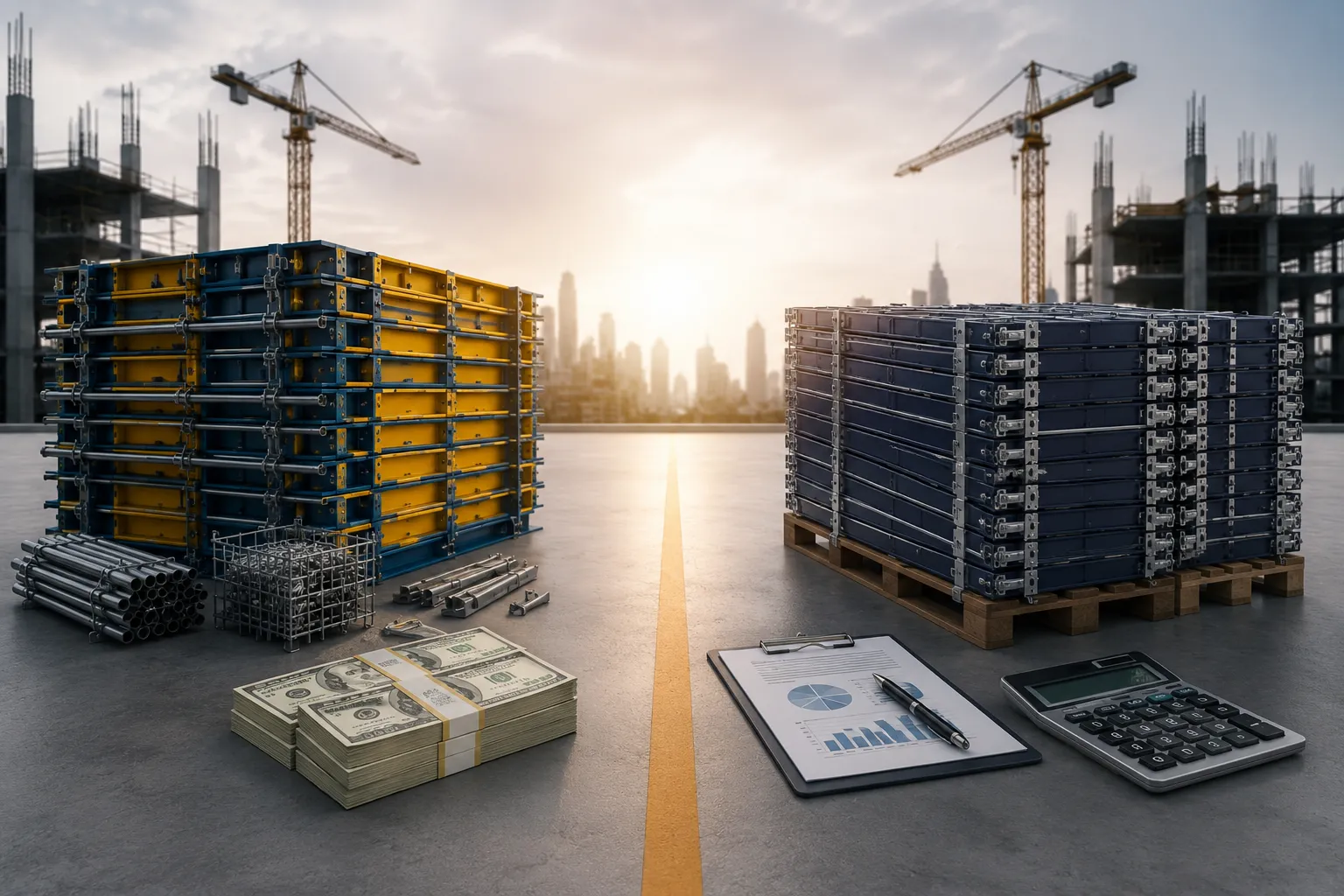
From a financial governance perspective, formwork procurement directly affects whether costs are treated as capital expenditure or operational expenditure. Ownership converts formwork into a depreciable asset on the balance sheet, increasing CAPEX and asset base. This can be advantageous for developers with strong balance sheets seeking asset-backed growth or long-term portfolio optimization.
Rental shifts the same cost into OPEX, improving short-term cash flow and reducing balance sheet intensity. For developers operating under tight financing covenants or preferring asset-light models, this distinction is decisive. In volatile markets, OPEX-heavy structures often provide greater resilience by reducing exposure to asset impairment.
The strategic choice between CAPEX and OPEX is therefore inseparable from the Formwork Rental vs. Ownership decision and must align with broader corporate financial policy.

Maintenance, Repair, and Lifecycle Costs
Ownership transfers full responsibility for maintenance, repair, and performance degradation to the developer or contractor. Over time, formwork faces wear from concrete abrasion, handling damage, and environmental exposure. These factors reduce efficiency, increase labor time, and can compromise surface quality if not properly managed.
Rental providers typically absorb these lifecycle costs, delivering systems that meet predefined performance standards at each rental cycle. While rental rates implicitly include maintenance costs, they also eliminate unpredictability. For developers prioritizing schedule certainty and quality consistency, this risk transfer is often undervalued in simplistic cost comparisons.
Storage, Logistics, and Transportation Considerations
Owned formwork requires storage during idle periods, often across multiple project gaps. Warehousing costs, inventory management, and transportation between sites introduce hidden overheads that accumulate over time. These costs are rarely captured in initial purchase calculations but significantly affect total cost of ownership.
Rental models externalize much of this logistical burden. Systems are delivered when needed and returned upon project completion, aligning cost directly with utilization. In dense urban environments or regions with limited storage infrastructure, this logistical efficiency strongly favors rental solutions.
Project Duration and Utilization Rate Analysis
Utilization rate is the central variable in determining whether buying formwork becomes economically justified. High utilization across long-duration or repetitive projects increases the economic efficiency of ownership. Low utilization, idle periods, or irregular project pipelines rapidly erode the assumed benefits of purchase.
For example, large-scale housing developments using repetitive layouts may achieve sufficient cycle repetition to justify ownership of systems such as a Tunnel Formwork System. Conversely, short-duration or bespoke projects often fail to reach the utilization threshold required to outperform rental models.
Depreciation, Resale Value, and Tax Implications
Owned formwork depreciates over time, both technically and financially. Depreciation schedules can offer tax advantages, reducing taxable income during early asset life. However, resale value is highly dependent on market demand, system condition, and compatibility with prevailing construction standards.
In contrast, rental costs are typically fully deductible as operating expenses in the period incurred, simplifying tax treatment. For developers prioritizing accounting simplicity and predictable tax outcomes, rental may present a cleaner solution.
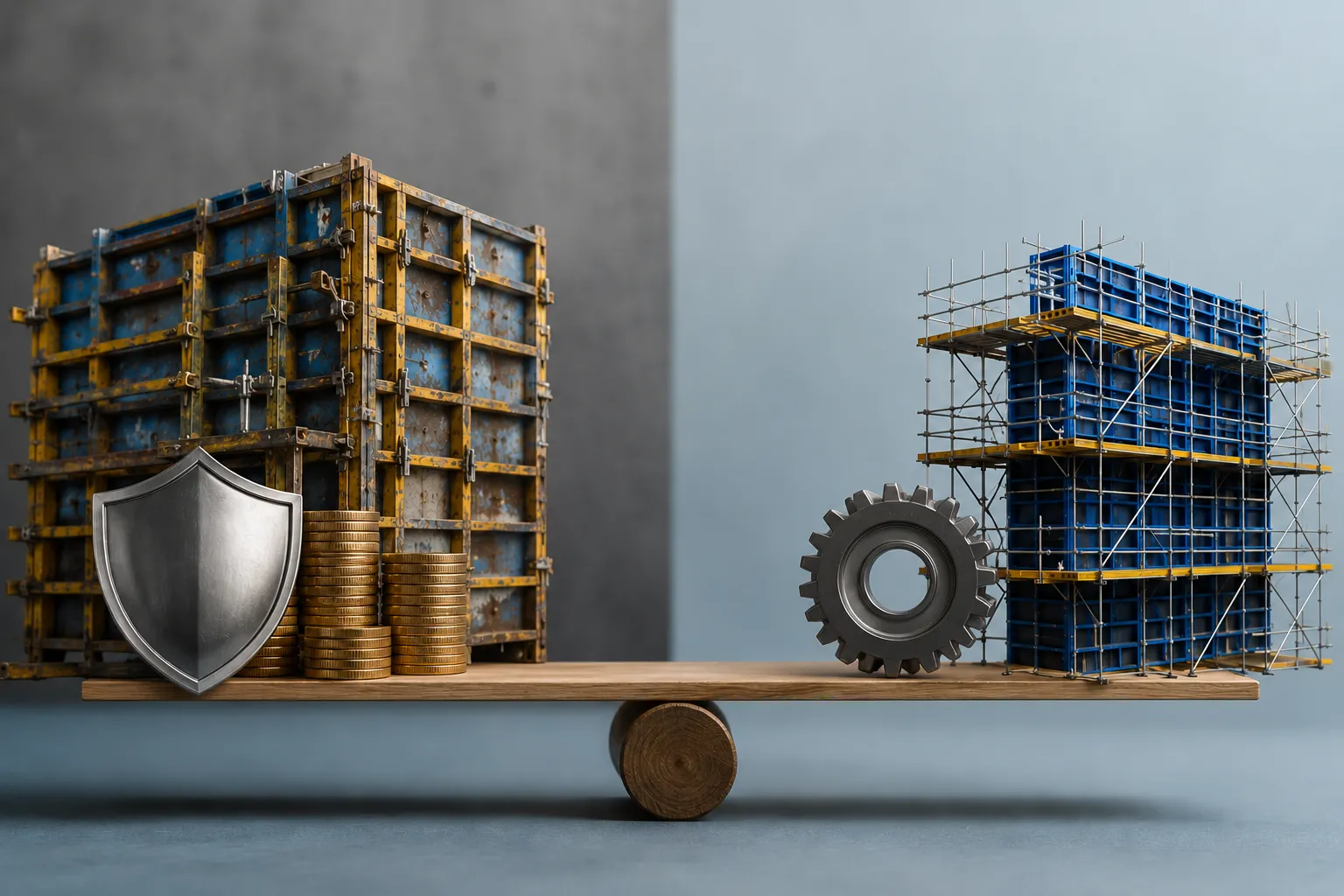
Risk Management and Market Availability
Ownership exposes developers to market risk, including technological obsolescence and demand shifts. A system optimized for one project type may become inefficient or redundant in future developments. Rental mitigates this risk by enabling access to a broader range of systems as project requirements evolve.
Availability risk must also be considered. In peak construction cycles, rental supply constraints can affect schedules. Long-term infrastructure projects, such as those requiring Tunnel Lining Formwork, may justify ownership simply to secure guaranteed availability over extended durations.
Scalability and Flexibility in Large Developments
Large developers often manage multiple concurrent projects with varying technical demands. Rental provides scalability, allowing rapid adjustment of quantities and system types without permanent commitment. Ownership, while potentially more economical at scale, reduces flexibility and increases coordination complexity across projects.
Strategic developers increasingly adopt portfolio-level analysis rather than project-by-project decisions when evaluating Formwork Rental vs. Ownership.
When Rental Makes Strategic Sense
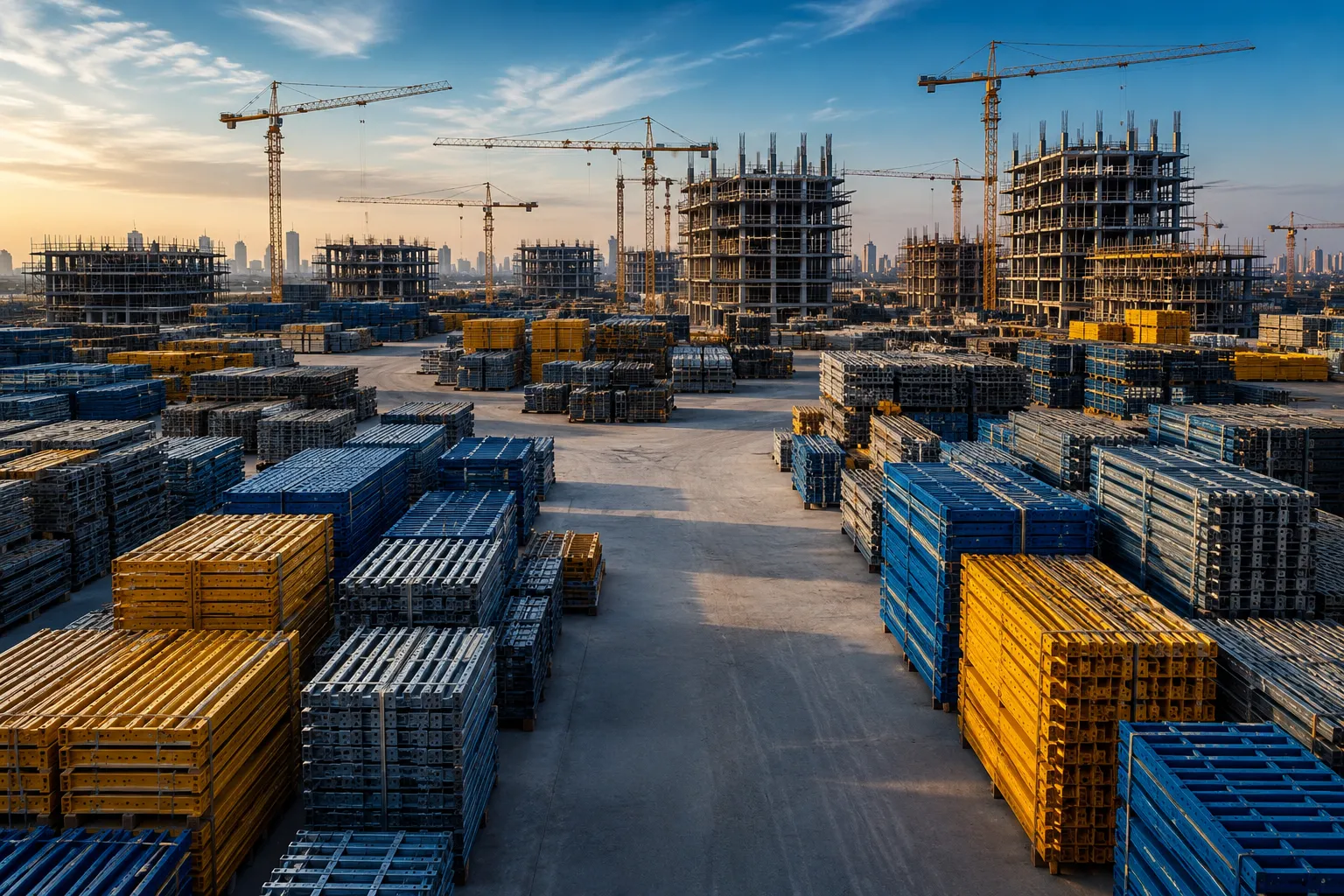
Rental is typically advantageous in projects with short durations, uncertain pipelines, limited storage capacity, or high design variability. It aligns well with asset-light strategies, improves cash flow resilience, and reduces operational risk. For developers entering new markets or testing unfamiliar construction typologies, rental minimizes exposure while maintaining technical performance.
When Ownership Becomes More Profitable
Ownership tends to outperform rental in long-term, repetitive, high-volume developments where utilization is consistently high and technical requirements remain stable. Developers with integrated construction arms and strong asset management capabilities are best positioned to capture ownership benefits.
Hybrid Procurement Strategies
Many sophisticated developers now employ hybrid strategies, owning core systems while renting specialized or peak-demand components. This approach balances capital efficiency with flexibility and is increasingly common in mixed-use and phased mega-projects.
Conclusion: Making a Data-Driven Decision
Formwork Rental vs. Ownership is not a binary choice but a strategic optimization problem. The correct decision depends on financial structure, project typology, utilization assumptions, and risk tolerance. Developers who approach this decision with rigorous financial modeling and technical understanding gain a measurable competitive advantage.
FAQs: Formwork Rental vs. Ownership
Is renting or buying formwork cheaper in the long run ?
The answer depends on utilization rate, project duration, and lifecycle costs. High utilization favors ownership, while intermittent use favors rental.
How does formwork rental affect project cash flow ?
Rental reduces upfront capital requirements and aligns costs with project progress, improving short-term liquidity.
Can owned formwork be resold easily ?
Resale depends on system condition, market demand, and compatibility. It should not be assumed as guaranteed value recovery.
Are rental systems technically inferior to owned systems ?
No. Rental systems are often maintained to high standards and may outperform poorly maintained owned equipment.
Is a hybrid strategy practical for mid-sized developers ?
Yes. Hybrid procurement is increasingly common and allows balance between cost efficiency and flexibility.